
Polyurethane bumpers for absorbing industrial impact and vibration
Polyurethane bumpers are elastomer components designed to absorb impact and damp vibration on industrial equipment. Their high elasticity and abrasion resistance protect machinery and structures, return energy without permanent deformation and last longer than rubber.
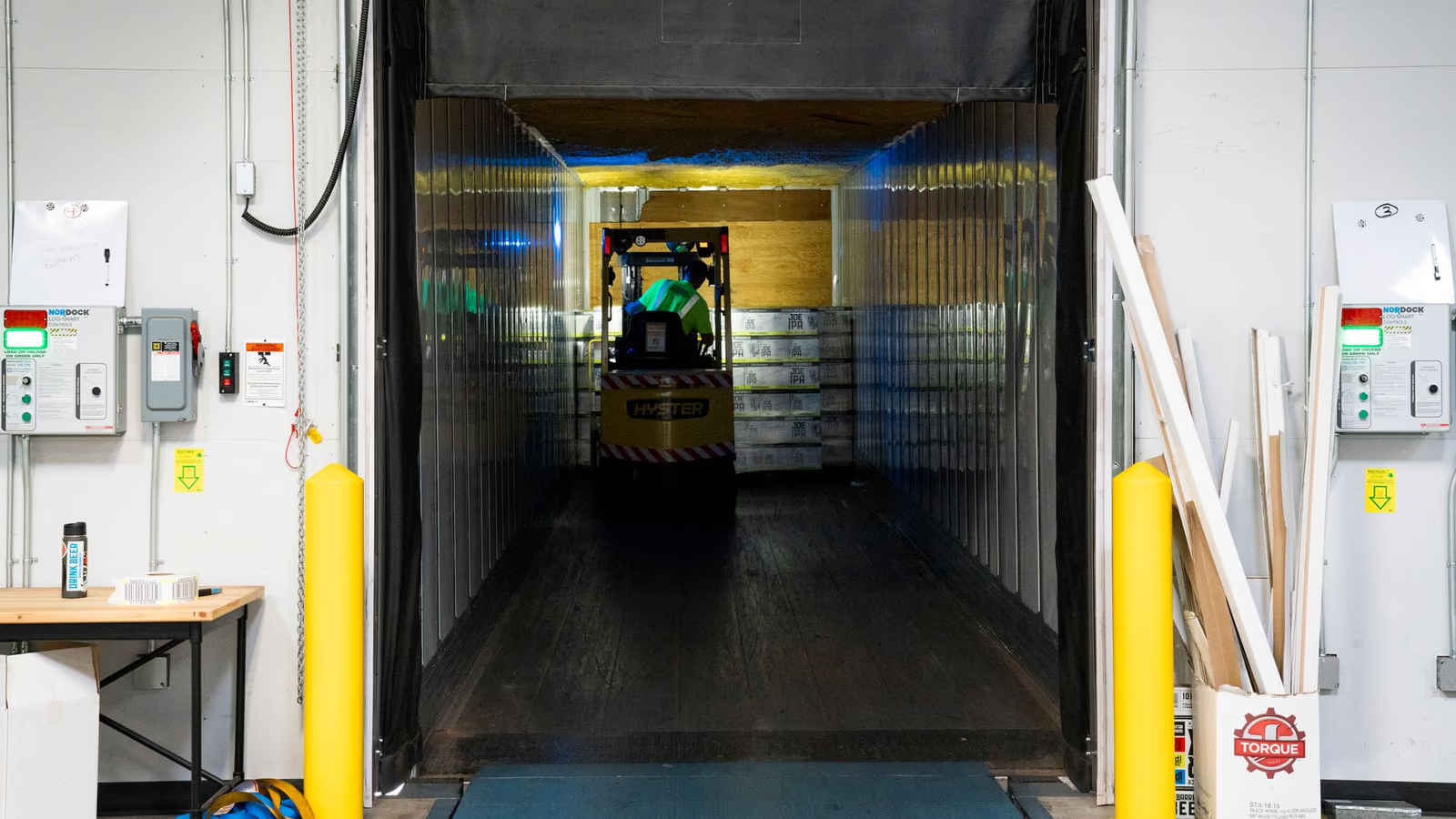
Polyurethane bumpers are elastomer components designed to absorb impact and damp vibration on industrial equipment. Their high elasticity and abrasion resistance protect machinery and structures, return energy without permanent deformation and last longer than rubber.
In a plant, one poorly absorbed impact can crack a frame, knock a conveyor out of alignment or stop an entire line. Vibration quietly attacks bearings, welds and fasteners. The right damper can therefore mean the difference between dependable equipment and a series of unplanned repairs. This is why so many engineering teams use high-performance elastomer solutions to protect their facilities.
How polyurethane bumpers absorb impact
When a moving mass strikes a surface, its energy must go somewhere. A rigid material such as steel returns it through rebound and noise while also absorbing part of the shock itself. An elastomer compresses instead, dissipates some energy as heat and then returns to its original shape.
Polyurethane excels in this role. Its particular molecular structure, characterized by phase separation between hard and soft segments, provides both rigidity and high elastic recovery. As a result, it damps repeated impact without tiring as quickly as traditional materials.
Impact and vibration are two different problems
Two needs that are often confused should be distinguished:
- Impact absorption means withstanding an isolated, violent shock, such as a forklift contacting a loading dock.
- Vibration damping means isolating a machine from continuous oscillations that wear parts and transmit noise.
When properly formulated and sized, impact-resistant polyurethane can meet both needs in one component, simplifying the design. The properties of industrial polyurethane help explain why the material outperforms so many alternatives in demanding environments.
Why choose polyurethane instead of rubber?
Rubber remains a common choice for damping, but its limitations appear quickly under continuous load. Polyurethane offers better abrasion, tear and hydrocarbon resistance while retaining its shape after thousands of compression cycles. Where a rubber pad sags and cracks, a properly formulated bumper maintains its performance.

The following table summarizes the most useful differences to understand before specifying a part.
| Criterion | Polyurethane | Rubber | Steel |
|---|---|---|---|
| Impact absorption | Excellent | Good | Low |
| Abrasion resistance | Very high | Moderate | High |
| Hydrocarbon resistance | High | Low | High |
| Elastic recovery | Excellent | Good | None |
| Weight | Light | Light | Heavy |
These differences directly affect service life and maintenance costs. A more detailed comparison of polyurethane and rubber helps determine which material suits the intended application.
Unsure which damper fits your equipment? A discussion with a technical team specializing in elastomers can often identify the right hardness and geometry before the first part is produced.
Selecting the right hardness for the application
Hardness, measured on the standardized Shore hardness scale under ASTM D2240, largely determines a damper’s behaviour. A softer part deforms more and better absorbs light impact, while a harder part supports high loads without being crushed.
Cast bumpers and dampers generally cover a range from approximately 40A to 90A Shore, as shown for custom-moulded bumpers and dampers. The right balance depends on three factors:
- The load to be absorbed and its distribution over the contact surface.
- The impact frequency, from occasional shocks to rapid, continuous cycles.
- The environment, including temperature, humidity, dust and oil exposure.
Soft, medium or hard
Soft polyurethane works well for positioning pads and minor vibration. Medium hardness covers most common industrial uses. Harder polyurethane is reserved for heavy loads and highly abrasive surfaces. The Shore hardness guide provides practical reference points that help prevent specification errors.
Industrial applications for impact bumpers
Polyurethane impact bumpers are used wherever masses move, meet or vibrate. Their versatility explains their adoption in sectors ranging from mining to material handling.

Common applications include:
- Loading docks protected from repeated contact by trucks and trailers.
- Overhead cranes and carts fitted with end-stop buffers that absorb residual energy.
- Vibrating machinery, screens and conveyors isolated from the floor to reduce wear and noise.
- Presses and OEM equipment whose sensitive components need protection from mechanical shock.
Many of these parts combine a metal core with an elastomer covering. Bonding polyurethane to metal then provides secure attachment while the resilient section absorbs force, a common construction for dock bumpers and anti-vibration pads.
Conclusion
Polyurethane bumpers offer a durable, economical answer to the impact and vibration that threaten industrial equipment. With the right hardness, geometry and mounting method, a plant reduces failures, noise and unplanned downtime while extending facility service life. To turn every impact into absorbed energy rather than an expensive failure, have your requirements assessed by elastomer moulding specialists who can validate the actual loads and constraints.
FAQ
What are polyurethane bumpers used for in industrial settings?
Polyurethane bumpers absorb impact and damp vibration on industrial equipment. Installed on docks, overhead cranes or machines, they protect structures and components from repeated shock. Their elasticity returns part of the energy without permanent deformation, extending facility service life and reducing costly production shutdowns.
Which Shore hardness should be used to damp impact?
The choice depends on the application. A low hardness around 40A provides high flexibility for light impact, while a high value near 90A better withstands heavy loads and abrasion. Medium hardness often offers a balance between absorption and mechanical strength. Validate the load, impact frequency and temperature before setting the final hardness.
Is polyurethane more durable than rubber?
In most high-impact applications, polyurethane outperforms rubber. It offers better resistance to abrasion, hydrocarbons and tearing while retaining its shape after repeated compression. Rubber remains appropriate for some economical applications, but it degrades more quickly under continuous load. For impact parts exposed to intensive cycles, polyurethane is generally the more cost-effective choice.
Can polyurethane bumpers be bonded to metal?
Yes. Proven bonding processes create a strong connection between polyurethane and metal. This construction makes it possible to produce dampers and bumpers with a metal core for mounting while the elastomer absorbs impact. Careful bonding prevents separation under repeated load and extends part life. Surface preparation and primer selection remain critical.