
Industrial Polyurethane: Properties, Benefits and Applications
A high-performance elastomer that combines the abrasion resistance of plastic with the elasticity of rubber, for parts exposed to wear, impact, and heavy loads.
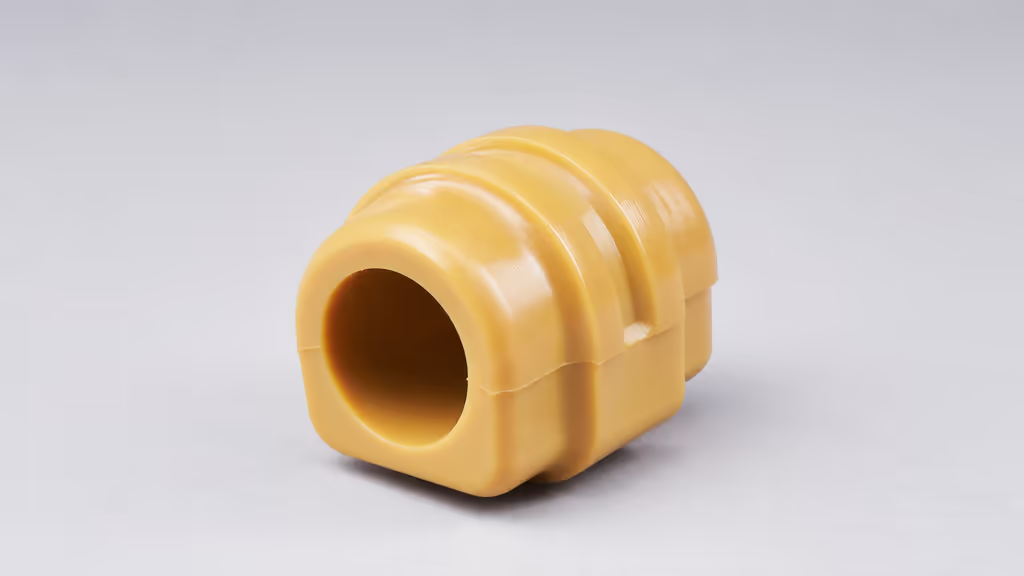
Industrial polyurethane is a high-performance elastomer that combines the abrasion resistance of plastic with the elasticity of rubber. Its properties make it ideal for parts exposed to wear, impact, and heavy loads across the mining, forestry, and material handling sectors.
A roller that wears out in a few weeks, a seal that cracks under load, downtime that costs thousands of dollars: these problems often share a single cause, a material poorly matched to real field conditions.
That is exactly where this material changes the equation for plants and operating sites. This guide explains the properties, benefits, and applications of urethane in plain language. It helps maintenance managers and technical buyers decide when this choice genuinely extends equipment life.
What Is Industrial Polyurethane
Industrial polyurethane refers to a family of synthetic elastomers molded to spec for demanding environments. Unlike rigid plastics or standard rubber, it sits in between: soft enough to absorb shock, tough enough to take abrasion for years.
An elastomer between rubber and plastic
This material molds into almost any shape, from rollers to liners to seals and pads. That versatility is why it shows up across so many sectors where wear is the main enemy of productivity.
TDI- and MDI-based formulations
Performance comes from the chemistry. Compounds are built mainly on two families of isocyanates, TDI and MDI, plus specialized additives. By adjusting the recipe, a manufacturer changes hardness, rebound, and chemical resistance to fit a specific application.
The Key Properties Behind Its Performance
Urethane's properties explain its reputation as an anti-wear material. They rarely combine in any single other product, which makes it a sought-after solution when several constraints stack up on the same part.
- Abrasion resistance superior to rubber and many plastics
- High load capacity without permanent deformation
- Good shock and vibration absorption, which lowers noise
- Resistance to oils, greases, and several solvents depending on the formulation
- Lower weight than an equivalent steel part
These characteristics are documented among the industrial applications of polyurethane recognized worldwide, from wheels to floor coverings.
Advantages of Polyurethane Over Other Materials
The real advantage is measured in service life and total cost. A part that lasts longer spaces out replacements, reduces stoppages, and lowers maintenance labour. The table below summarizes the relative strengths of the most common materials.
| Criterion | Polyurethane | Rubber | Steel |
|---|---|---|---|
| Abrasion resistance | Excellent | Good | Low to moderate |
| Shock absorption | High | High | Low |
| Weight | Light | Light | Heavy |
| Service life in severe wear | Long | Moderate | Variable |
To go further, a comparison of polyurethane and rubber details the cases where each material keeps the edge. The right choice always depends on the environment, loads, and service temperature.
Every application imposes its own load, speed, and temperature constraints. Before ordering custom parts, it pays to validate the formulation with specialists: requesting a technical quote gets you a recommendation matched to your real conditions.
Common Industrial Applications
Uses multiply as soon as a part faces friction, impact, or repeated load. Urethane shows up in the most heavily worked equipment on production lines and extraction sites.
- Conveyor rollers, wheels, and idlers
- Liners and wear plates for hoppers and chutes
- Dust seal rings for crushers and mining equipment
- Screening panels, pads, and dampeners
- Custom parts for material handling, forestry, and snow removal
Conveyor rollers and wheels illustrate the gain well: by replacing steel or rubber with urethane, many operators reduce the frequency of unplanned interruptions on their lines.
How to Choose the Right Formulation
Choosing a part is not just about the type of material. Hardness, the molding process, and the fastening method all directly influence final performance.
Shore hardness as the starting point
Hardness determines whether the part will be soft or rigid. Softer formulations absorb shock better, while harder ones resist cutting and abrasion more. The Shore hardness guide and the Shore hardness scale explain how to read these values, from the soft 60A range up to the rigid 75D range.
Metal bonding for composite parts
Many parts combine a steel core with a urethane layer. The quality of adhesion then governs service life. A well-controlled bonding process prevents debonding under load, a key concern for rollers and drive wheels subjected to continuous stress.
Conclusion
Well chosen, industrial polyurethane extends equipment life, reduces downtime, and lowers total cost over several years. Its properties, load capacity, and abrasion resistance make it a logical solution whenever wear threatens productivity. To turn those gains into concrete results, the best step is to talk to an engineering team able to analyze your real conditions before production begins.
FAQ
What is industrial polyurethane and what is it used for?
Industrial polyurethane is a synthetic elastomer molded to spec for demanding environments. It often replaces rubber, steel, or plastic in parts exposed to wear, impact, and abrasion. It is found in the rollers, wheels, liners, and seals of mining, forestry, and material handling equipment. Its adjustable formulation delivers the exact hardness and resistance each application needs to last.
What is the difference between polyurethane and rubber?
Polyurethane generally offers better abrasion resistance, higher load capacity, and longer service life than rubber. Rubber keeps an edge on certain elasticity criteria and initial cost. The choice depends on the environment, loads, and service temperature. For parts under severe wear, urethane clearly spaces out replacements and limits production stoppages.
How do you choose the right Shore hardness for a part?
Shore hardness determines how soft or rigid the finished part is. Softer formulations, around 60A to 80A, absorb shock better and reduce noise. Harder formulations, up to the 75D range, resist abrasion and cutting more. The right choice depends on loads, speed, and the type of contact. An engineering team can validate the formulation before production.
Does industrial polyurethane resist chemicals?
Yes, several industrial polyurethane formulations offer good resistance to oils, greases, and certain solvents, depending on the chemical components used. Resistance varies from one recipe to another, however, because no material suits every environment. TDI- or MDI-based compounds and specialized additives tune chemical and thermal resistance. The exact chemical contact must be specified at the design stage.