
Polyurethane vs Rubber: When to Switch and Why It Matters
The key differences between polyurethane and rubber, the conditions where polyurethane clearly wins, and how to make the right call for your application.
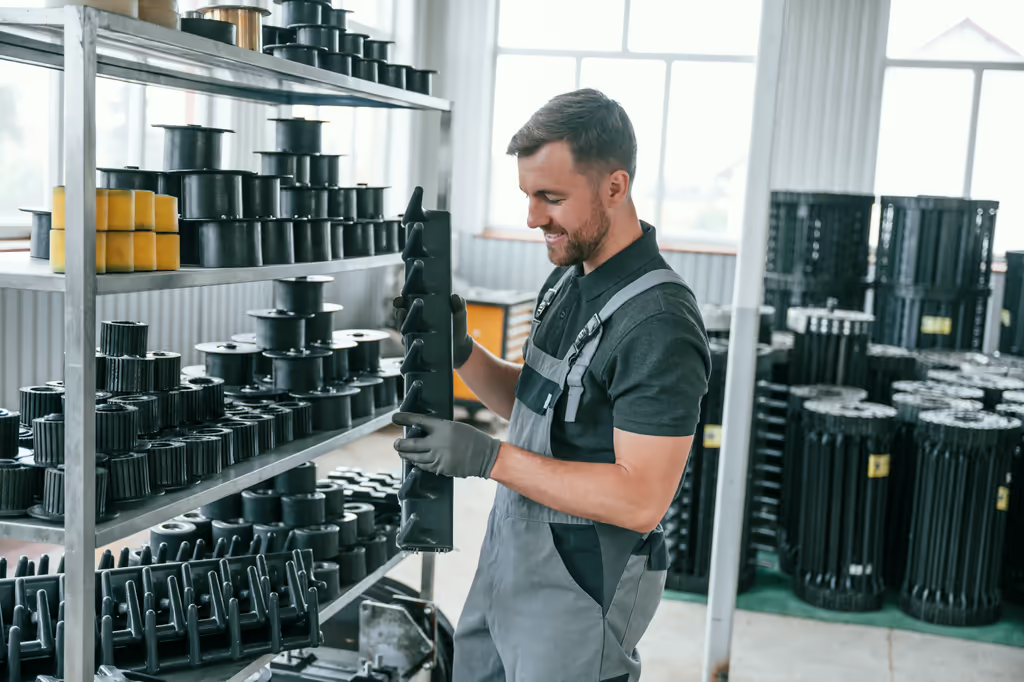
You replace a worn rubber part. Two months later, you are replacing it again. If that cycle feels familiar, the problem might not be maintenance. It might be the material itself.
In industrial environments where abrasion, load, and chemical exposure are constant, the polyurethane vs rubber debate has a direct impact on equipment uptime, replacement costs, and operational efficiency. Polyurethane is not always the right answer, but understanding when it is can save significant time and money over the long run.
This article breaks down the key differences between the two materials, the conditions where polyurethane clearly wins, and how to make the right call for your specific application.
Polyurethane vs Rubber: Key Material Differences
At a material level, polyurethane is a polymer that sits between rubber and rigid plastic on the hardness spectrum. It can be formulated across a wide range of shore hardness values, making it exceptionally versatile.
Both natural and synthetic rubber are known for their elasticity, vibration dampening, and ease of moulding. They perform well in applications that prioritize flexibility and compression at lower loads.
Polyurethane, by contrast, offers a distinct set of properties that become critical in demanding environments:
- Higher abrasion resistance than most rubber compounds
- Greater load-bearing capacity without permanent deformation
- Better resistance to oils, fuels, and many solvents
- Wider hardness range, from very soft (Shore A 20) to near-rigid (Shore D 80+)
- Longer service life under high-wear conditions
The trade-off is that polyurethane generally performs less well in high-temperature environments and with certain chemicals like strong acids or ketones.
Head-to-Head Comparison
| Property | Natural Rubber | Polyurethane |
|---|---|---|
| Abrasion resistance | Moderate | Excellent |
| Load capacity | Low to moderate | High |
| Oil and fuel resistance | Poor | Good |
| Flexibility at low temps | Good | Moderate |
| High-temperature resistance | Moderate | Limited (above 80-100°C) |
| Hardness range | Narrow | Very wide |
| Customization | Moderate | Extensive |
| Typical service life (heavy wear) | Shorter | Longer |
This polyurethane vs rubber comparison reflects general behaviour. Actual performance depends on the specific rubber compound (NBR, Viton, EPDM, neoprene) and the polyurethane formulation used.
When Polyurethane Outperforms Rubber
High-abrasion and Impact Environments
This is where polyurethane consistently demonstrates its advantage. In mining, aggregate processing, and material handling, parts are constantly subjected to sliding, scraping, and impact from hard particles.
Rubber wears down relatively quickly under these conditions. Polyurethane, particularly in mid-to-high hardness formulations, resists surface degradation far more effectively. According to abrasion resistance testing documented by Gallagher Corporation using ASTM standard methods, polyester-based polyurethane outperforms rubber in sliding abrasion tests, often by a significant margin.
Parts like crusher dust seal rings, polyurethane conveyor rollers, and screening panels are prime candidates for a material switch.
Load-bearing Applications
Rubber deforms under sustained load, a phenomenon called compression set. Once the material takes a permanent set, it no longer seals or functions as intended.
Polyurethane maintains its shape under heavy, sustained loads much better. This makes it the preferred choice for industrial polyurethane wheels, rollers, and structural components that carry significant weight during normal operation.
Oil and Chemical Exposure
Standard rubber degrades when exposed to petroleum-based fluids. Polyurethane handles oils, greases, and many industrial fluids much better, extending the life of seals, gaskets, and protective components in environments with frequent fluid contact. The same holds for polyurethane bumpers and gaskets exposed to impact and oil.
Not sure which side of the polyurethane vs rubber debate fits your equipment? Request a quote and get a material recommendation tailored to your operating conditions.
When Rubber Is Still the Right Choice
Polyurethane is not universally superior. Rubber remains the better option in several conditions:
- Extreme heat: Above roughly 100 °C, most polyurethane compounds begin to degrade. Rubber formulations like EPDM or silicone handle higher temperatures more reliably.
- Strong chemical exposure: Concentrated acids, ketones, and certain solvents attack polyurethane. Specialized rubber compounds or Viton may be necessary.
- Dynamic vibration dampening: For pure shock absorption and low-frequency vibration isolation, rubber's natural elasticity is difficult to replicate.
- Very low-load, low-wear applications: If a part simply does not face significant abrasion or load, the cost difference may not justify switching materials.
Choosing the right material requires an honest assessment of the operating environment, not a blanket preference for one compound over another.
How to Evaluate Whether to Switch
If you are unsure how to approach the polyurethane vs rubber decision for your operation, consider asking these questions before your next order:
- Is the part failing due to surface wear, or due to deformation or cracking?
- What temperatures does the part regularly encounter?
- Is there oil, chemical, or solvent exposure?
- What loads does the part carry, and are they sustained or dynamic?
- Is the part currently made from natural rubber, NBR, or another synthetic?
If wear and load are the dominant failure modes, polyurethane is almost always worth evaluating. If heat or specific chemical exposure is the primary issue, the answer may be a different rubber compound rather than a switch to polyurethane.
The Role of Custom Formulation
One of the most significant advantages of working with a specialized polyurethane manufacturer is access to custom formulations. Off-the-shelf rubber parts are designed to cover a broad range of applications. Custom polyurethane parts are engineered for a specific set of conditions.
The manufacturing of each part starts with a review of the application requirements. Hardness, elongation, tear resistance, and chemical compatibility are all considered before a formulation is selected. The result is a part that performs better and lasts longer than a generic replacement.
This level of customization is especially valuable for components that are difficult to source, have unusual geometries, or operate in particularly aggressive environments. Our custom molded polyurethane parts are built to the drawing, sample or worn part you supply.
Conclusion
The polyurethane vs rubber decision comes down to the specific demands of your application. In environments defined by abrasion, heavy loads, and oil exposure, polyurethane typically delivers a longer service life and lower total replacement cost. In high-heat or highly corrosive environments, rubber compounds or specialty elastomers may be the better fit.
Getting the material right the first time reduces downtime and cuts the hidden costs of frequent part replacement.
If you are evaluating a material switch or looking to replace a worn part with a more durable solution, contact our team for a consultation tailored to your equipment and operating environment.
FAQ
In a polyurethane vs rubber comparison, what is the main advantage in mining applications?
In a polyurethane vs rubber comparison for mining, polyurethane wins on abrasion resistance. Parts are constantly exposed to abrasive rock, heavy impact, and sliding wear, and polyurethane handles these conditions significantly better than standard rubber. Its surface degrades far more slowly under repeated abrasion, which directly reduces replacement frequency, lowers maintenance costs, and keeps equipment running longer between planned shutdowns.
Can polyurethane replace rubber in all industrial sealing applications?
Not in all cases. Polyurethane performs well in sealing applications involving oils and moderate chemicals, but it is not suitable for high-temperature environments above approximately 100 °C or for exposure to strong acids and ketones. In those situations, specialized rubber compounds or materials like Viton are the better option. The right material always depends on the actual operating conditions, not a blanket preference for one compound.
How do I know if my rubber part should be replaced with polyurethane?
The clearest indicators are repeated failures due to surface wear, permanent deformation under sustained load, or degradation caused by oil and solvent contact. If any of these is the primary failure mode, switching to polyurethane is worth evaluating seriously. A custom manufacturer can assess your specific application, identify the root cause of failure, and recommend the appropriate compound and hardness for your equipment.