
Reducing Conveyor Downtime with Polyurethane Rollers and Wheels
Where polyurethane rollers and wheels outperform conventional materials, and what to specify when ordering them to meaningfully reduce downtime.
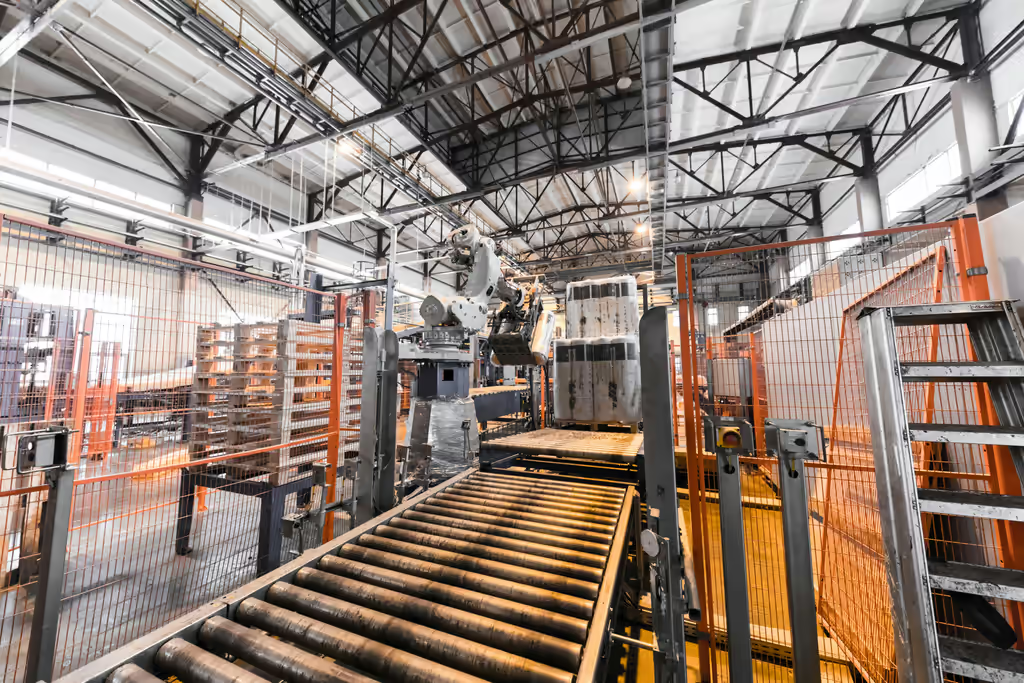
When a conveyor stops unexpectedly, the cost adds up fast. Replacing a seized roller, a flat-spotted wheel, or a failed drive component means lost production time, labour, and in some operations, a cascade of downstream disruptions. Switching to polyurethane rollers and wheels is one of the most direct ways to reduce how often that happens.
The components that keep a conveyor moving are often treated as low-value consumables. Rollers and wheels in particular are frequently replaced on a reactive basis, with procurement focused on initial cost rather than service life. This approach tends to increase total maintenance costs rather than reduce them.
Understanding where polyurethane rollers and wheels outperform conventional materials, and what to specify when ordering them, is the starting point for meaningful downtime reduction.
Why Polyurethane Rollers and Wheels Outperform the Rest
Before selecting a replacement material, it helps to identify the actual failure mode. The most common causes of premature roller and wheel failure in conveyor systems include:
- Abrasive wear on the rolling surface from contact with abrasive material or rough flooring
- Flat spotting caused by overloading or prolonged static loads that permanently deform the contact area
- Bearing contamination from debris entering through inadequate sealing
- Core failure in plastic or hollow steel rollers under impact loading
- Noise and vibration that accelerate fatigue and indicate misalignment or load issues
Each failure mode points to a different specification requirement. A roller that flat-spots under load needs a harder compound with better load capacity. A roller that wears quickly on an abrasive surface needs a compound with high abrasion resistance. These are not always the same formulation.
How Polyurethane Addresses These Failure Modes
Polyurethane's combination of properties makes it effective across several of the common failure modes simultaneously.
Abrasion resistance
Polyurethane consistently outperforms natural rubber and most plastics in sliding abrasion tests. In applications where the roller surface contacts rough, sharp, or abrasive material, a mid-to-high hardness polyurethane compound (typically Shore A 70 to 95) provides significantly longer surface life than softer alternatives.
This directly reduces the frequency of roller replacement in applications like aggregate handling, mining conveyor systems, and material sorting lines. Our custom polyurethane rollers are cast to the hardness that matches each of these conditions.
Load capacity without flat spotting
Unlike softer elastomers, properly specified polyurethane maintains its shape under sustained heavy loads. The higher load-bearing capacity reduces the risk of permanent deformation at the contact point, which is one of the primary causes of premature roller failure in high-load applications.
For heavy-duty conveyor systems, rollers in the Shore A 85-95 range or Shore D 40-55 range can support loads that would quickly flatten softer compounds.
Noise and impact damping
Steel rollers transmit noise and impact force directly through the conveyor frame. Polyurethane-covered rollers absorb a portion of impact energy at the contact surface, reducing both noise levels and vibration transmitted to the conveyor structure.
This is particularly relevant in indoor facilities with occupational noise regulations, and in applications where conveyor vibration affects surrounding equipment or structures.
Chemical and moisture resistance
Polyurethane resists oils, water, and many industrial fluids that degrade natural rubber. In applications where the conveyor operates in wet or chemically active environments, polyurethane maintains its properties more reliably than standard rubber covers.
Rollers vs Wheels: Understanding the Difference
These terms are sometimes used interchangeably, but they refer to different components with different load orientations.
| Component | Load Direction | Typical Application |
|---|---|---|
| Conveyor roller | Radial (perpendicular to axis) | Belt support, return idlers, drive rollers |
| Industrial wheel | Axial and radial | Carts, trolleys, overhead conveyors |
| Drive sprocket | Torque transmission | Chain conveyors, drive systems |
Both benefit from proper compound selection when abrasion, load, and noise are factors. The specification approach is the same: match hardness and compound to the operating conditions, not just the physical dimensions.
Our team manufactures custom parts for industrial conveyor and material handling applications, with in-house machining to exact dimensions.
Looking for polyurethane rollers and wheels for your conveyor system? Request a quote from our team and include your operating conditions for an accurate compound recommendation.
What to Specify When Ordering Polyurethane Rollers
Ordering polyurethane rollers and wheels as simple dimensional replacements is a missed opportunity. To get the performance improvement that polyurethane is capable of delivering, the specification should address:
- Outer diameter and length (or width for wheels)
- Core material: steel, aluminum, or existing core to be recovered
- Shaft or bore specifications: diameter, keyway, bearing type
- Shore hardness: based on load, speed, and surface material in contact
- Compound type: standard polyurethane, or a specific formulation for chemical or temperature resistance
- Surface finish: smooth, crowned, grooved, or textured depending on the application
- Operating load and speed: critical for verifying compound selection
Providing this information to a manufacturer allows for a part that is engineered for the application rather than sourced as a catalog substitute.
For applications where downtime costs are high, it is worth calculating the total cost of ownership (purchase price plus installation labour plus lost production) rather than comparing only unit price. A polyurethane roller that lasts three times longer than a rubber one at twice the price delivers a clear economic advantage.
Maintenance Practices That Extend Roller Life Further
Even the best-specified polyurethane roller will underperform if maintenance practices are not aligned with material requirements.
- Inspect for surface wear at scheduled intervals, not only when a failure occurs. Early identification of wear allows planned replacement instead of emergency replacement.
- Check alignment regularly. Misalignment increases edge loading on the roller surface and accelerates wear at the contact margins.
- Monitor bearing condition. Polyurethane extends the rolling surface life, but bearing contamination remains a separate failure mode that requires proper sealing.
- Avoid prolonged static loads. Even high-hardness polyurethane can take a compression set if a loaded conveyor sits idle for extended periods. Where possible, reduce the load before extended shutdowns.
Combining well-specified polyurethane rollers and wheels with consistent maintenance practices produces the best outcomes. According to data from Aberdeen Research via IIoT World, unplanned downtime costs industrial manufacturers an average of $260,000 per hour across sectors. Even modest reductions in conveyor-related stoppages have a meaningful financial impact.
Conclusion
Polyurethane rollers and wheels reduce conveyor downtime by addressing the most common failure modes (abrasive wear, flat spotting, and impact damage) more effectively than rubber or plastic alternatives in demanding applications. The key is specifying the right compound and hardness for the actual operating conditions, not simply replacing one part with a dimensionally equivalent one.
Treating conveyor rollers and wheels as precision components rather than standard consumables is a straightforward way to reduce maintenance frequency and total cost.
Ready to upgrade to polyurethane rollers and wheels for your conveyor system? Contact us or submit a quote request with your equipment specifications.
FAQ
How much longer do polyurethane rollers and wheels last compared to rubber ones?
Service life depends heavily on the application, but polyurethane rollers and wheels typically outlast standard rubber by a factor of two to four in high-abrasion environments like mining conveyor systems or aggregate handling. The advantage is most pronounced where abrasive material contact and sustained heavy loads are constant factors. Proper compound and hardness selection are what determine whether that service life advantage is fully realized in practice.
Can polyurethane be applied to an existing steel roller core?
Yes. Polyurethane can be cast onto an existing metal core using the metal-to-polyurethane bonding process, provided the core is in acceptable structural condition. The core is cleaned, blasted, and primed before casting. This approach can be cost-effective for large or custom-dimensioned rollers where the metal core is expensive to manufacture from scratch.
What shore hardness is recommended for heavy-duty conveyor rollers in mining?
Most heavy-duty conveyor rollers in mining applications are specified between Shore A 80 and Shore A 95. This range provides strong abrasion resistance and adequate load capacity while retaining enough elasticity to absorb impact. The exact value depends on the load per roller, belt speed, and the abrasiveness of the material being conveyed.